PennFuture Navigation

Bear in the Woods: Environmental Law Blog
Showing posts with label air pollution. Show all posts

Wednesday, February 04, 2015

Permit applications for shale gas wells within one mile of a Washington County school: Withdrawn.

In October 2014, citizens from Mt. Pleasant Township in Washington County reached out to PennFuture for assistance. Range Resources had submitted three conditional use permit applications to the township board for consideration. The permits, if approved, would allow Range to develop three new natural gas well pads and accessory facilities, two of which would join an already existing well pad, placing three within one mile of the Fort Cherry K-12 school campus. PennFuture provided legal counsel at four well-attended public hearings and was preparing testimony for several more when Range abruptly pulled the applications on Tuesday, February 3, citing economic reasons. 

Washington County is a drilling hot spot in Pennsylvania, with wells popping up across all zoned districts, including in county parks, and by homes and schools. Some residents are fed up with this unchecked expansion, which allows gas development anywhere in the township. Several nearby permit violations by Range Resources, along with heavy truck traffic, around-the-clock noise from generators, and bright lights in an otherwise pastoral setting, prompted a group of citizens to ask that the township deny the approvals that would allow these industrial operations in close proximity to homes and schools - and particularly in areas where persons bought homes in reliance on the area being zoned for only residential development.

In addition to quality of life considerations, residents opposed the permits based on concerns related to a growing body of research documenting the health risks associated with the drilling process. Health professionals and parents alike argue that concentrating diesel truck traffic around families and their homes makes no sense. Diesel exhaust is a known carcinogen as well as an air pollutant linked to a variety of respiratory and heart diseases. Studies such as one conducted in 2014 by McKenzie, et al. revealed that pregnant mothers living within ten miles of natural gas wells had higher incidences of congenital heart diseases in their children. Furthermore, the risk of certain birth defects was positively correlated with increased well density. 

As research continues to reveal real risks, citizens are beginning to look to their local governments for appropriate zoning restrictions on natural gas drilling. 

Mt. Pleasant Township modified its land use ordinance to allow natural gas development across all zoned districts prior to enactment of the state natural gas law (Act 13). In the recent Robinson Township case, the Pennsylvania Supreme Court struck down those portions of Act 13 that compelled local municipalities to allow natural gas development across all zoned districts. Mt. Pleasant Township is now in the process of revising its land use ordinance.

In deciding where to permit drilling and where to restrict it, Mt. Pleasant Township faces the same challenge as many municipalities around Pennsylvania: how to strike a balance between shale gas development and protection of the environment and the public’s health and safety. When ruling on components of Act 13 pertaining to local zoning, as set forth in Robinson Township, the Supreme Court made it clear that municipalities cannot allow non-conforming uses in residentially zoned districts – and it goes without saying that shale gas development is not a residential land use.

Valessa Souter-Kline is western Pennsylvania outreach coordinator for PennFuture and is based in Pittsburgh. She tweets @ValessaSK.

Wednesday, August 28, 2013

Third Circuit Preserves Common Law Nuisance Claims To Correct Harmful Air Emissions

Counsel for property owners residing near dirty coal plants will be pleased with the Third Circuit's decision in Bell et al. v. Cheswick Generating Station, Genon Power Midwest, L.P., No. 12-4216 (3d Cir. Op. filed Aug. 20, 2013). The Third Circuit held that the federal Clean Air Act does not pre-empt state law nuisance claims.

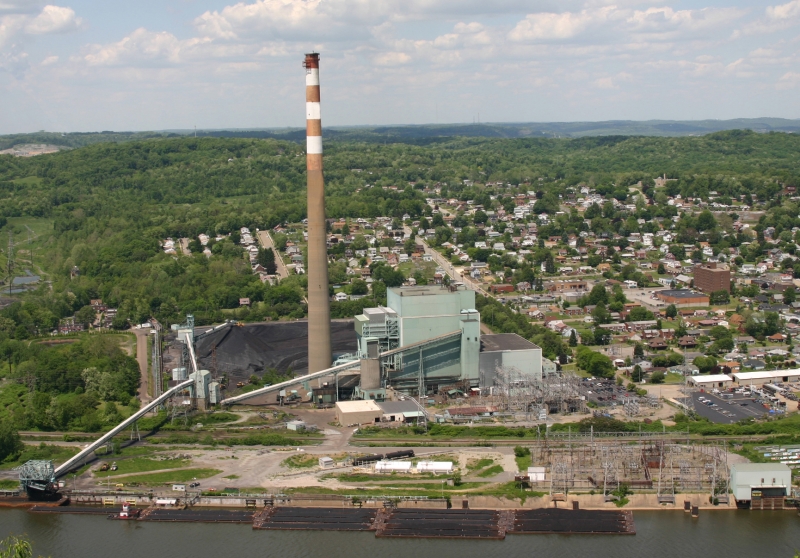
Plaintiffs Bell and Luppe were named plaintiffs in a class action representing 1,500 persons residing near Genon's 750-megawatt coal-fired power plant located in a bedroom community north of Pittsburgh along the Allegheny River.  The community, Springdale, also happens to be home to one of the finest old-fashioned custard stands east of the Mississippi.
Genon Power Plant
Springdale, Pa.

Plaintiffs sued under a variety of state law tort theories, alleging that ash and other contaminants from the plant were harming their property. Genon sought summary judgment, asserting that the Clean Air Act (CAA) pre-empted the state law claims.

The CAA's citizen suit provision contains a savings clause that reads:
"Nothing in this section shall restrict any right which any person (or class of persons) may have under any statute or common law to seek enforcement of any emission standard or limitation or to seek any other relief (including relief against the Administrator or a State agency)."
The CAA also contains a so-called "state's rights" savings clause that protects the right of states to impose limits that are more stringent than federal law.

In a matter of first impression, the Third Circuit's analysis was guided by the Supreme Court's decision in International Paper Co. v. Ouellette, 479 U.S. 481 (1987).  There, property owners on a lake sued under state common law theories for reduced property values being caused by a pollutional discharge into the lake.  The Supreme Court found that the Clean Water Act's (CWA) savings clauses preserved the right of states to impose standards that were more stringent than federal law, and that those more stringent standards could be imposed either by statute or through the common law.

Finding no meaningful difference between the savings clauses under the CAA and CWA, the Third Circuit properly concluded that Ouellette controlled its decision and remanded the case to the district court for further proceedings.

The CAA's national ambient air quality standards are intended to protect public health and welfare. The secondary standards, in particular, are designed to prevent impacts to things such as buildings.  As a practical matter, compliance with those standards should shield good operators from these types of common law nuisance suits. But the Third Circuit recognized that the principles of cooperative federalism embodied in the CAA provide plaintiffs another tool to redress harm where the federal regulatory framework fails to prevent harm to local residents, as alleged in this case.

In Pennsylvania, the General Assembly has made it difficult for the state to adopt regulatory standards that are more stringent than federal law. Section 4.2(b) of Pennsylvania's Air Pollution Control Act prohibits the Environmental Quality Board from adopting control measures and other requirements that are more stringent than federal law without substantial justification. As such, the Third Circuit's decision preserving common law nuisance claims has particular import for Pennsylvania residents allegedly being harmed by air pollution.